WEEKLY MARKET SUMMARY
Global Equities: It was a tumultuous week for equity investors as bulls and bears fought for control of the market and uncertainty clouded the path of Fed interest rate policy. The artificial intelligence trade passed a critical test as Nvidia (NVDA) delivered earnings and markets looked ready for lift off on Thursday morning, but sentiment quickly shifted and profit taking turned major indices sharply lower. A Friday rebound kept the damage contained to a -2.0% pullback for the S&P 500, while the Dow Jones Industrial Average lost -1.9% and the Nasdaq Composite ended -2.7% lower. US small caps got a little boost Friday from optimism that the Fed will cut rates but still ended the week down -0.8%. Developed market international stocks were down -2.7% for the week, while emerging markets shed -3.4%.
Fixed Income: The 10-Year Treasury yield was lower as risk-off sentiment grew and the likelihood of a Fed rate cut rose. The big news in the bond market was the surge in Japanese government debt, with the 10-year Japanese bond yield hitting its highest level since 2008 and the 30-year bond reaching an all-time high. The uptick in Japanese yields stems from new Prime Minister Sanae Takaichi’s $135 billion stimulus package, which has also triggered a slump in the yen.
Commodities: Oil prices were under pressure as the US once again attempted to restart peace talks between Russia and Ukraine, while simultaneously escalating tensions with Venezuela. US West Texas Intermediate ended the week at $58/barrel. Gold prices slipped but held the $4,000 mark, ending the week at $4,057/oz. “Digital gold” was hit with heavy selling, as bitcoin fell -13.6% during the week to end around $84,500 after a brief trip below $80,000.
WEEKLY ECONOMIC SUMMARY
Better Late Than Never Jobs Report: Data-starved investors finally got some official government economic news as the September jobs report was released, revealing that US employers added 119,000 jobs during the month. The job gains were at the high end of the expectations range, although the news was dampened somewhat by a rise in the unemployment rate to 4.4%, the highest level in nearly four years. Unfortunately for investors and the Fed, the October jobs report was canceled due to the government shutdown, along with the October Consumer Price Index inflation report.
Forecasting the Fed: Investors’ heads were spinning this week trying to get a handle on the likelihood of a Fed rate cut at the upcoming December 10th policy meeting, with odds swinging dramatically, according to data from CME Group’s Fedwatch tool. The probability of a rate cut slipped to under 30% on Thursday before the jobs report was released and investors began pricing in roughly even odds of a cut. On Friday morning, New York Fed President John Williams said there was still room for a cut, which caused odds of a 25-basis-point cut to spike higher to around 72%. With limited economic data and intense political pressure to cut, the December meeting will be one of the most pivotal in recent memory.
Earnings Season Update: The main event of earnings season took place during the week as Nvidia (NVDA) took the stage, reporting yet another quarter of jaw-dropping results. Revenue grew 62% year over year to hit $57 billion during the quarter and the chipmaker offered guidance of $65 billion for the fourth quarter. Investors were keenly attuned to CEO Jensen Huang’s take on the “AI bubble” argument that Nvidia’s customers are overestimating the useful life of their chips and will face a large write-down event in the coming years. Huang addressed these concerns by arguing that older GPUs, in some cases six years old, are still being used at full capacity today. Investors initially appeared to be sold on the narrative, sending shares 5% higher post-earnings, but those gains quickly evaporated and Nvidia ended the week nearly 6% lower.
CHART OF THE WEEK
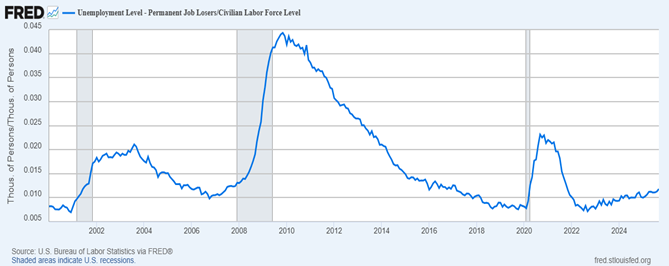
The Chart of the Week shows the number of “Permanent Job Losers”, which measures workers who permanently lost a job in the last few years and remain out of the labor force, as a percentage of the total civilian labor force (16 years or older). The number of “permanent” unemployed persons has risen to above 2 million, which is 1.2% of the labor force. Permanent job losers increased by 98,000 in September and were the primary driver of the inflation increase to 4.4%. A rise in permanent job losses can indicate a “low hiring” environment in which new job creation fails to keep pace with losses, and will likely be a topic of discussion at the December Fed meeting.